Detect PAD and autonomic neuropathy in one seven-minute test.
Smart-LEDA+ is the only point-of-care platform that combines true cuff-based ABI, TBI, and sudomotor function testing in a single, medical-assistant-operated workflow.
Designed for CPT 93922 / 93923 / 95923 · HIPAA secure · HITRUST-certified cloud
already run the Smart-ABI Process. 5 to 7 minutes per test, run by a trained medical assistant, read and signed into the EMR.
Smart-LEDA+ sees what an ABI-only device can't.
The sudomotor module measures the smallest unmyelinated nerve fibers at the foot, the earliest marker of autonomic-nervous-system dysfunction and a leading indicator of diabetic peripheral and autonomic neuropathy. Paired with true cuff-based ABI and TBI, it delivers a complete lower-extremity disease assessment in one workflow.
- Vascular + autonomic in one visit: no second appointment, no referral out.
- Detects dysfunction conventional exams miss: even when the standard foot exam appears normal.
- Up to 59% of PAD patients have no symptoms: early detection is the whole point.
Source: 2024 ACC/AHA/Multisociety Guideline for Lower Extremity PAD: asymptomatic PAD represents 20% to 59% of objectively proven PAD. Accessed October 31, 2026.
Schedule a Demo →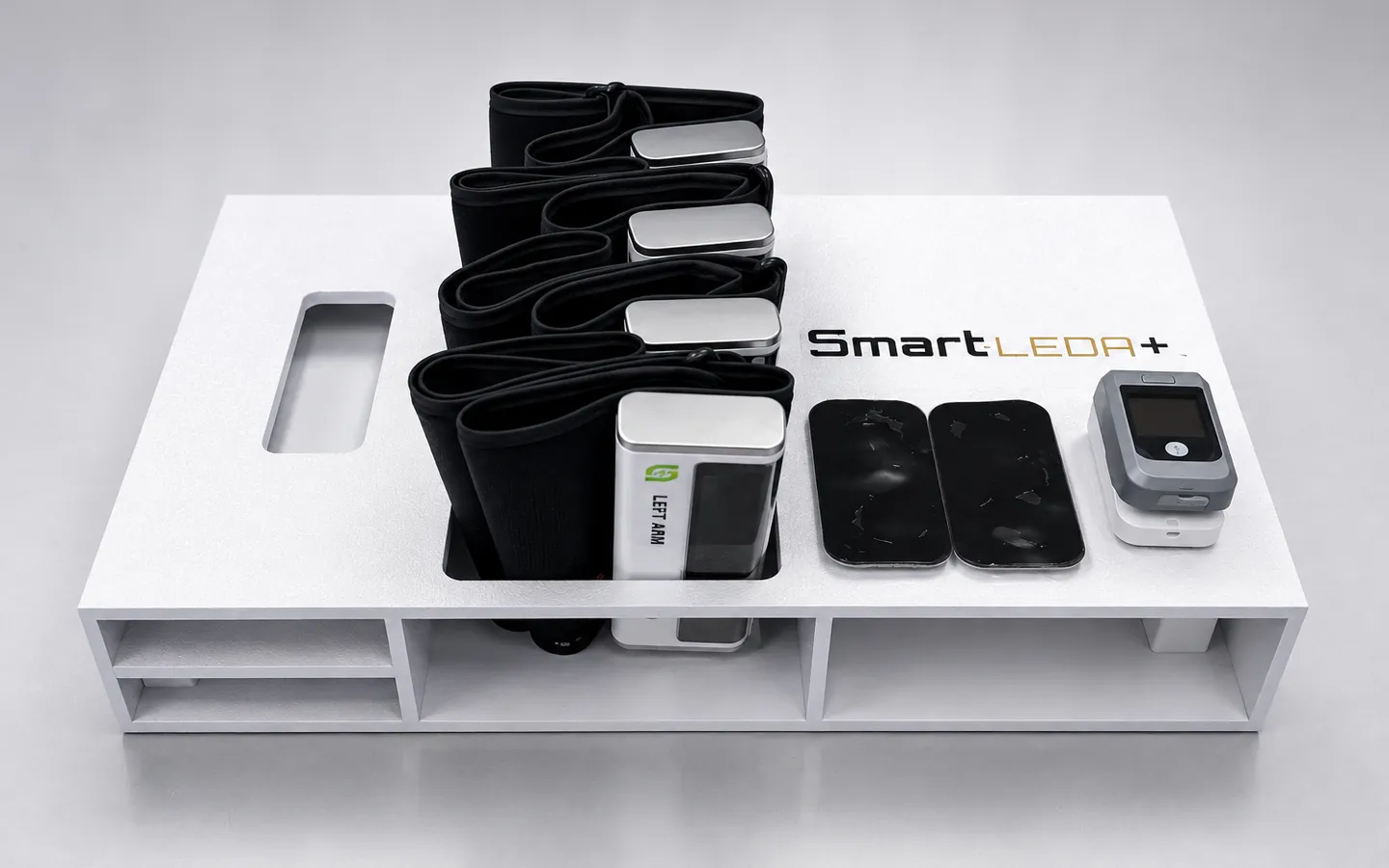
How the platform compares
| Smart-LEDA+ | Typical ABI-only device | |
|---|---|---|
| ABI / VPR vascular reading | Yes | Yes |
| True cuff-based methodology (not a PPG substitute) | Yes | Some |
| Toe-Brachial Index for incompressible vessels | Yes | Some |
| Sudomotor / autonomic-neuropathy testing | Yes | No |
Sources for the sudomotor row are listed on the Smart-LEDA+ page.
Which device fits your practice?
Need ABI only?Smart-ABI → Incompressible vessels?Smart-ABI+ → Vascular and autonomic in one visit?Smart-LEDA+ → Compare all four devices →Which patients can we test?
A patient who meets any one of the following can be tested.
Patients over the age of 65
Patients over 50 with a history of diabetes, smoking, or both
High-risk patients with additional comorbidities, symptoms, or both
Any patient with a justified medical necessity
PAD symptoms to ask about
- Painful cramping or aching in the legs when walking
- Skin color changes on the legs and feet
- Shiny skin or hair loss on the leg
- Weak or no pulse in the legs or feet
- Sores on the toes, feet, or legs that do not heal
Who is at risk for PAD?
- Diabetes
- Smoking
- Obesity
- High cholesterol
- High blood pressure
- People 50 and over
- Family history
Coverage and payment policies vary by payer. Documentation and billing for arterial studies are covered in the Coding, Compliance, and Documentation Webinar.
From patient to EMR in seven minutes.
The Smart-ABI Process is built so a trained medical assistant can run the whole test before the physician enters the room.
Enter patient info
A comprehensive set-up screen guides patient selection and entry.
Apply wireless cuffs
Color-coded, wireless cuffs with directional arrows and an audio walkthrough.
One-click run
One-click activation captures ABI, VPR, TBI and sudomotor in about seven minutes.
Signed report to EMR
A color-coded report is ready to read, sign, and add to most major EMRs.
Coding, Compliance, and Documentation Webinar with Dr. Jeffrey Lehrman
Presented by Jeffrey Lehrman, DPM, FASPS, MAPWCA, CPC. How to document and bill arterial studies: what the report needs to state, the guidelines behind CPT 93922 and 93923, and how payer rules differ by insurer. Webinar details →
Three CPT codes, one workflow.
What each code describes, and which Smart-ABI study is designed for it.
Non-invasive physiologic studies of the extremity arteries at a single level, bilateral. The limited vascular study: Smart-ABI and Smart-ABI+ are designed for its documentation.
The same studies at multiple levels or with provocative maneuvers, as a complete bilateral study. Smart-ABI+ and Smart-LEDA+ vascular studies are designed for its documentation.
Testing of autonomic nervous system function: sudomotor. The Smart-LEDA+ sudomotor study is designed for its documentation.
Payment for a service a code describes is not guaranteed and depends on documentation and medical necessity. Reimbursement and ROI →
Descriptors: AMA CPT, as quoted by AAPC (93922, 93923) and Aetna Clinical Policy Bulletin 0485 (95921, 95923). Accessed October 31, 2026.
Peripheral artery disease is underdiagnosed.
A short animated overview of PAD, the patients who go undiagnosed, and where a Smart-ABI test fits in the visit.

Everything you need to evaluate the platform.
Products
Smart-LEDA+, Smart-ABI and Smart-ABI+, Smart-Neuro, and the Smart-ABI Hub. Start with one device, perfect the workflow, then scale.
Compare the family →By Specialty
How wound care, nurse practitioners, endocrinology, and podiatry practices run the same 5 to 7-minute, MA-operated test.
Find your fit →Why Smart-ABI
The 2026 documentation shift, the five pillars practices buy on, and the reimbursement math behind early detection.
See the case →Practices keep it running daily.
From 40+ five-star clinician reviews on Google, spanning podiatry, vascular, endocrinology, and multi-specialty groups.
“All of the MAs in our clinic are trained within a few minutes as the system walks you through the entire process.”
“Beneficial to both our practice in terms of revenue and in diagnosing peripheral vascular disease.”
“Takes just 5–8 minutes, and there is no need to be referred to a different practice or lab.”
The questions practices ask first.
How long does the test take?
What makes Smart-LEDA+ different from other ABI devices?
Does it qualify for CPT 93922, 93923, and 95923?
Who interprets the results?
Which patients can we test?
See the test in your own workflow.
Book a demo and a Smart-ABI specialist will walk your team through patient selection, the MA-operated workflow, reimbursement, and the report your EMR receives.