Find vascular and nerve disease in a single visit.
Smart-LEDA+ is the only wireless device in its class that combines true cuff-based ABI, Toe-Brachial Index, and sudomotor function testing in one point-of-care workflow. LEDA stands for Lower Extremity Disease Assessment: a complete vascular and autonomic-neuropathy picture in about seven minutes.
ABI + TBI + Sudomotor~7-minute full studyMA-operatedOnly device in its class
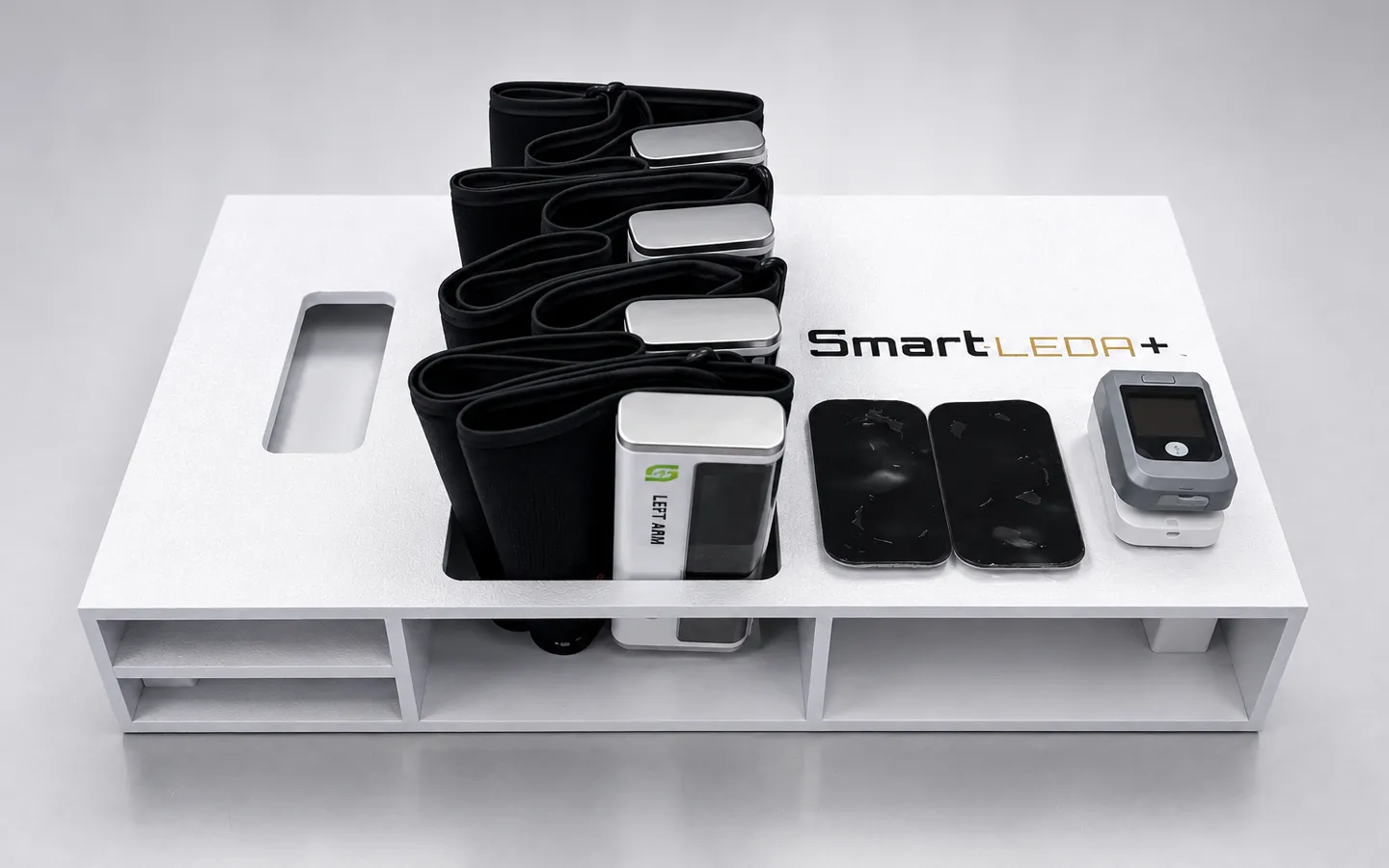
The Smart-LEDA+ kit: wireless cuffs, sudomotor electrode pads, and pulse oximeter in one tray.
One workflow, four modalities
A whole-person study, not just an ABI.
Smart-LEDA+ lets clinical teams perform rapid, non-invasive arterial studies and sudomotor function tests with the added accuracy of TBI and microvascular data, in one guided workflow an MA can run.
True cuff-based ABI with volume plethysmography records (VPR) waveforms for PAD detection.
Toe-Brachial Index (TBI) for patients with incompressible ankle vessels, common in long-standing diabetes, CKD, and advanced age. When to use ABI vs. TBI →
Sudomotor function testing to detect peripheral autonomic neuropathy, the earliest sign of autonomic nervous-system dysfunction.
Microvascular data for a more complete peripheral nerve and vascular assessment.
Only device in its class
True cuff-based ABI + VPRYes
Toe-Brachial Index (TBI)Yes
Sudomotor / autonomic neuropathyOnly Smart-LEDA+
Full study time~7 min
Competing point-of-care platforms (QuantaFlo, PADnet, MESI mTABLET, Sudoscan) do not combine cuff-based ABI, TBI, and sudomotor testing in one device.
The differentiator
Why test sudomotor function?
Sweat glands do not decide on their own to sweat; a nerve ending commands them. When sweat glands do not respond correctly, there is usually something wrong with the nerves controlling them, often before any clinical sign or symptom appears.
Earliest indicator
A sensitive early marker of small-fiber neuropathy that can detect autonomic dysfunction even when conventional exams appear normal.
Quantitative & objective
Non-invasive electrical conductance produces quantitative data that integrates with vascular indices (ABI/TBI), so change can be measured over time.
Catch it while reversible
Small nerve fibers can regenerate when the underlying insult is removed, so early detection supports timely, targeted intervention.
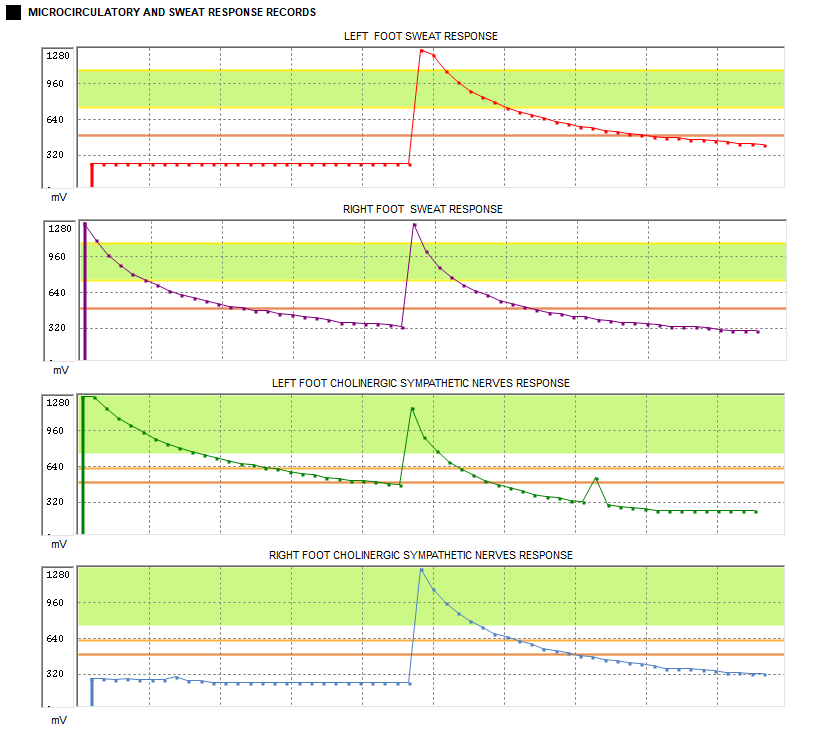
Microcirculatory and sweat response records from a Smart-LEDA+ sample report. Patient details removed. Select the image to view it full size.
Beyond ABI
Additional cardiovascular markers.
Alongside ABI, TBI, and sudomotor results, Smart-LEDA+ surfaces markers that help build a fuller cardiovascular risk picture.
Central Aortic Systolic PressureMarker of the pressure of the aorta.
Peripheral Augmentation IndexMarker of aortic stiffness.
Pulse Wave VelocityMarker of lower-extremity aortic stiffness.
Delta Left & Right ArmMarker of subclavian or axillary stenosis.
90%
Reported accuracy of ABI with VPR waveforms to diagnose PAD.
78%
Reported accuracy of Sweat-C sudomotor testing.
~7 min
Total throughput for both the vascular and sudomotor study.
Who it’s for
Built for whole-person, value-based care.
Endocrinology & diabetic care
The sudomotor module is uniquely suited to diabetic autonomic and peripheral neuropathy detection and longitudinal monitoring.
Autonomic neuropathy
Nurse practitioners
Detect autonomic neuropathy and PAD in one test, with a workflow an NP-led practice can run and document from day one.
Early detection
Wound care
Audit-defensible ABI documentation the way claims are reviewed today, plus a neuropathy picture that supports the treatment plan.
Documentation
ACOs & value-based care
Early detection and prevention translate directly to the value-based-care economic model and quality reporting.
Prevention
Questions
Smart-LEDA+ FAQ
What does Smart-LEDA+ test?
A true cuff-based Ankle-Brachial Index (ABI), Toe-Brachial Index (TBI), and sudomotor function testing in one wireless workflow, along with microvascular data. It assesses both peripheral artery disease and peripheral autonomic neuropathy.
How long does a full study take?
About five minutes for the vascular study alone, or roughly seven minutes for both the vascular and sudomotor studies, from entry of patient information to results in hand.
Why does sudomotor testing matter?
Sudomotor testing measures the smallest unmyelinated nerve fibers at the foot, among the earliest indicators of autonomic nervous-system dysfunction. It can detect changes before conventional exams appear abnormal, and small nerve fibers can regenerate when the underlying cause is addressed.
How accurate are the tests?
Per Hyperion Medical materials, ABI with volume plethysmography records (VPR) is reported at 90% accuracy to diagnose PAD, and Sweat-C sudomotor testing has been reported at 78%.
Who can run the test?
Smart-LEDA+ is designed for medical-assistant operation, with color-coded, wireless cuffs, directional arrows, one-click activation, and an audio-guided patient setup screen.
See Smart-LEDA+ in your own workflow.
Book a demo and a Smart-ABI specialist will walk your team through patient selection, the MA-operated ABI + TBI + sudomotor workflow, reimbursement, and the report your EMR receives.